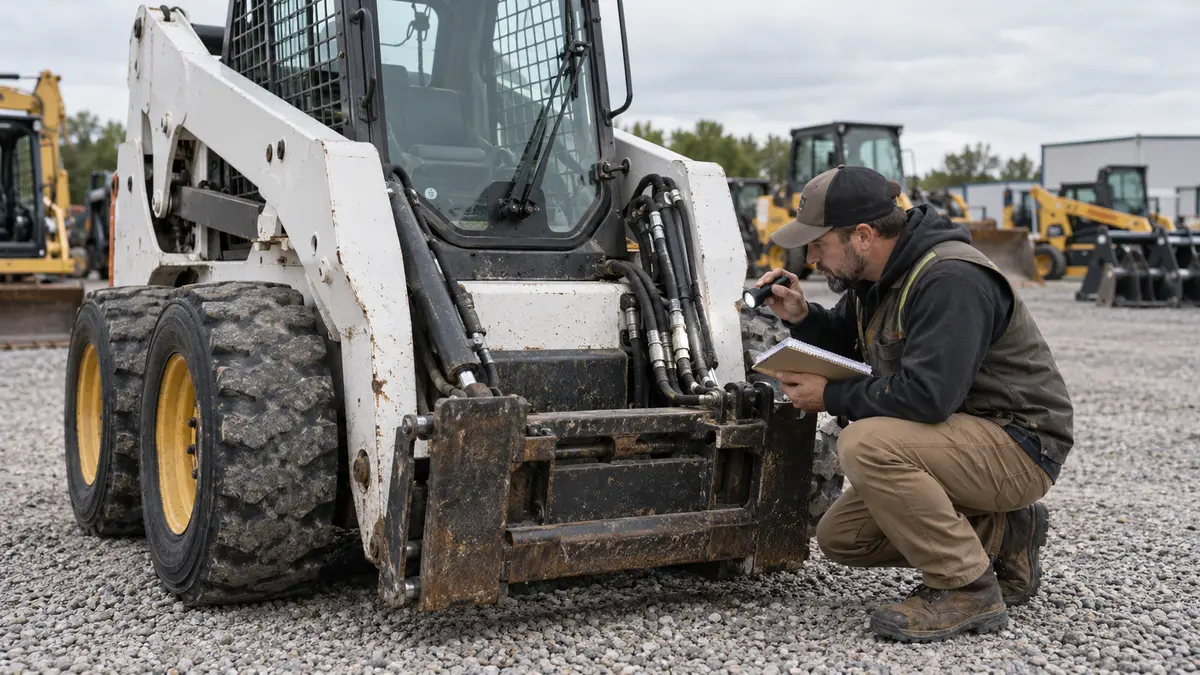
A skid steer inspection should leave you with more than “runs well.” You need to know what was assessed, which concerns need diagnosis, what work was quoted and which important items could not be tested.
Use this checklist to organize the purchase inspection of a wheeled skid steer. It is a record sheet for a buyer and qualified inspector, not instructions for servicing, lifting or diagnosing a loader yourself.
In This Guide
Prepare the Inspection Brief
Give the inspector the model, serial number, advertised hours, seller’s fault description, service records and your intended attachments. Explain the work you expect the loader to do. Ask for a scope and fee before the appointment, including whether any laboratory work or specialist assessment costs extra.
- Confirm the machine and included tools are available at the agreed location.
- Establish who will operate the loader during demonstrations.
- Ask what the site allows and which systems may remain untested.
- Request an evidence file with photographs and a written explanation of findings.
- Record whether the seller promises to complete any work before collection.
Stop for Unsafe Demonstration Conditions
NIOSH’s skid-steer alert identifies crushing risks and warns against disabling safety devices. Keep observation outside the machine’s operating area. Never reach beneath unsupported lift equipment or accept a demonstration that depends on a bypassed restraint or interlock. NIOSH: Preventing Injuries and Deaths from Skid-Steer Loaders.
Ask the inspector to assess safety concerns using the manufacturer’s procedure. A buyer’s desire to finish the checklist is not a reason to improvise a test. Record why a test did not proceed and what is required before it can safely be completed.
Document Each Area of the Loader
| Area | Evidence to Collect | Question to Resolve |
|---|---|---|
| Identification | Serial and display photographs | Does the history belong to this loader? |
| Tires and wheels | Condition findings for each position | What replacement or repair is recommended? |
| Lift structure and linkage | Inspector’s written findings and photos | Which concerns require measurement or specialist review? |
| Attachment connection | Assessment of the fitted connection and tool | Is the complete package suitable and correctly identified? |
| Power and drive systems | Results of agreed professional assessment | Which concerns are confirmed and which remain suspected? |
| Controls and operator area | Model-specific safety and function findings | What must be corrected before use? |
| Maintenance history | Dated invoices, inspections and follow-up | Which scheduled or corrective work remains outstanding? |
For a manufacturer example of the breadth of an inspection, Bobcat’s checklist covers visual, operational, safety and maintenance topics. Use the correct model documentation for the actual assessment rather than assuming every loader has identical systems. Bobcat: Machine Inspection.
Ask for Specific Operating Observations
The inspector should explain what was demonstrated and under what conditions. Was the intended attachment available? Was the machine assessed only in a small yard? Did an active warning or site restriction end the test? Preserve those limits in the report.
If a response seems abnormal, separate the symptom from its proposed cause. The budget should not treat a casual guess as a confirmed repair. Ask what further assessment would narrow the uncertainty and whether the machine should be operated before that happens.
Do not assign your own permissible movement, pressure or temperature limits from a general internet checklist. Different equipment and procedures call for different interpretation. Request the inspector’s basis for any pass/fail measurement used in the report.
Convert Findings Into Three Lists
| List | What Belongs Here | How to Use It |
|---|---|---|
| Resolve before use | Safety concerns or defects requiring correction | Do not plan productive operation until addressed |
| Price before purchase | Confirmed work and required equipment | Obtain an itemized quotation and availability |
| Investigate further | Unexplained observations and untested functions | Identify the next test or document needed |
Keep known repairs separate from a reserve for uncertainty. If a quotation has exclusions, copy them into your decision notes. A figure without its assumptions can make two candidates appear comparable when they are not.
Ask whether quoted work can be completed before the machine is needed. If collection requires special handling because of a fault, give that information to the transport provider before accepting its price.
Check That the Sale Package Matches the Inspection
A satisfactory assessment of one configuration does not automatically cover a changed package. If the seller swaps a bucket, tires or another included component after the viewing, document the change and ask whether any previous conclusion needs revisiting.
Before commitment, match the written agreement to the serial number and attachment list. Record promised repairs, how their completion will be verified, collection responsibilities and any stated coverage. Keep the original listing and correspondence with the inspection file.
Use the Findings to Decide
Continue only when you understand enough about fit, cost and condition for your own purchase conditions. Pause when a named piece of evidence could resolve a material concern. Pass when the configuration is wrong or the remaining uncertainty exceeds the budget you are comfortable committing.
The skid steer buying guide puts this inspection within the whole purchase process. Use the service-record guide to make the documents easier to assess before the inspector arrives.
Sources and Scope · Research checked September 18, 2026. U.S.-first buyer education. This is an editorial research guide, not a report on a machine we inspected. Equipment-specific procedures and limits belong in the correct manufacturer manual.
See our Editorial Policy and send a correction.