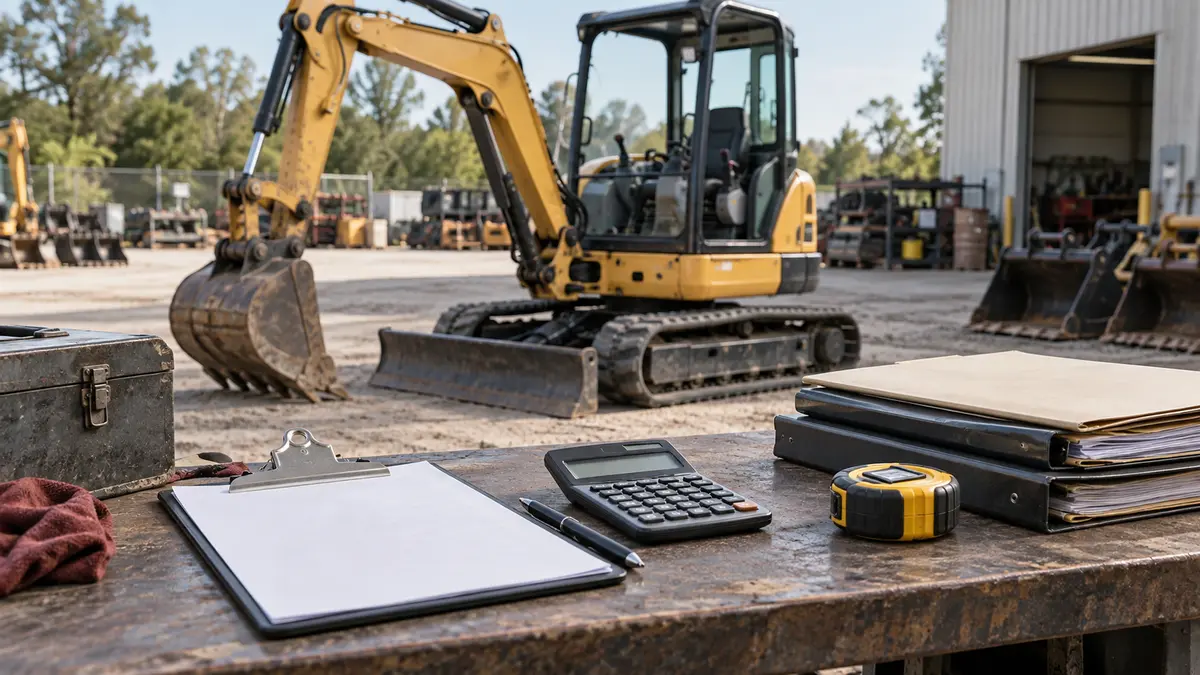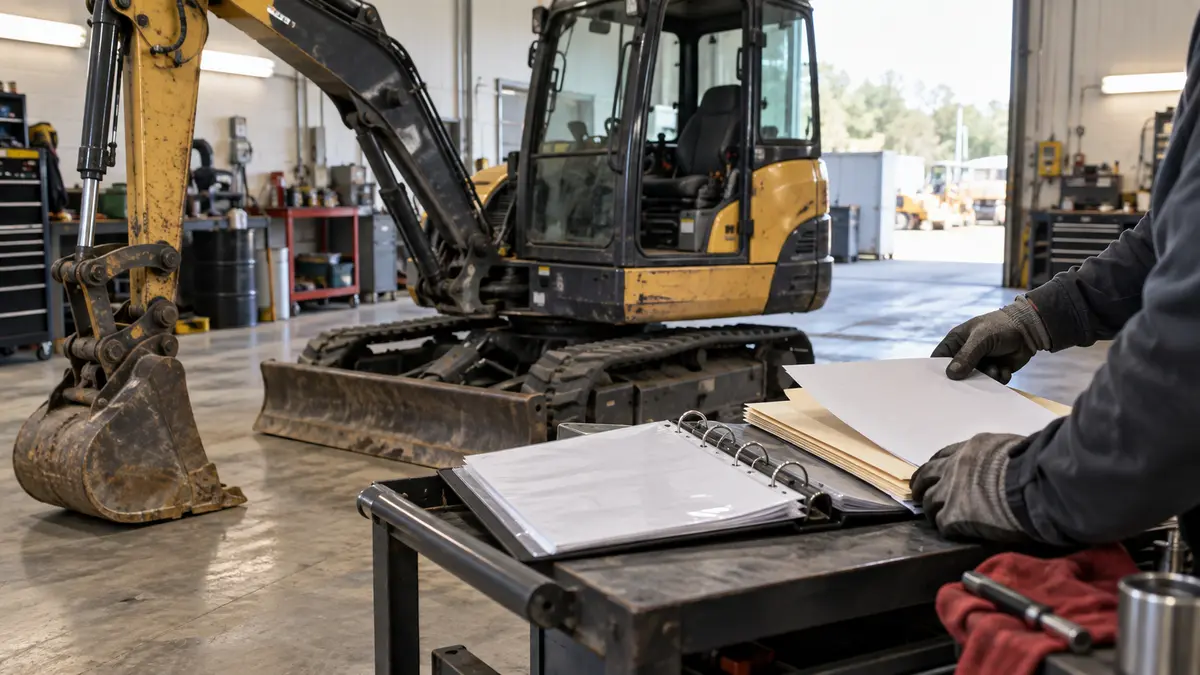
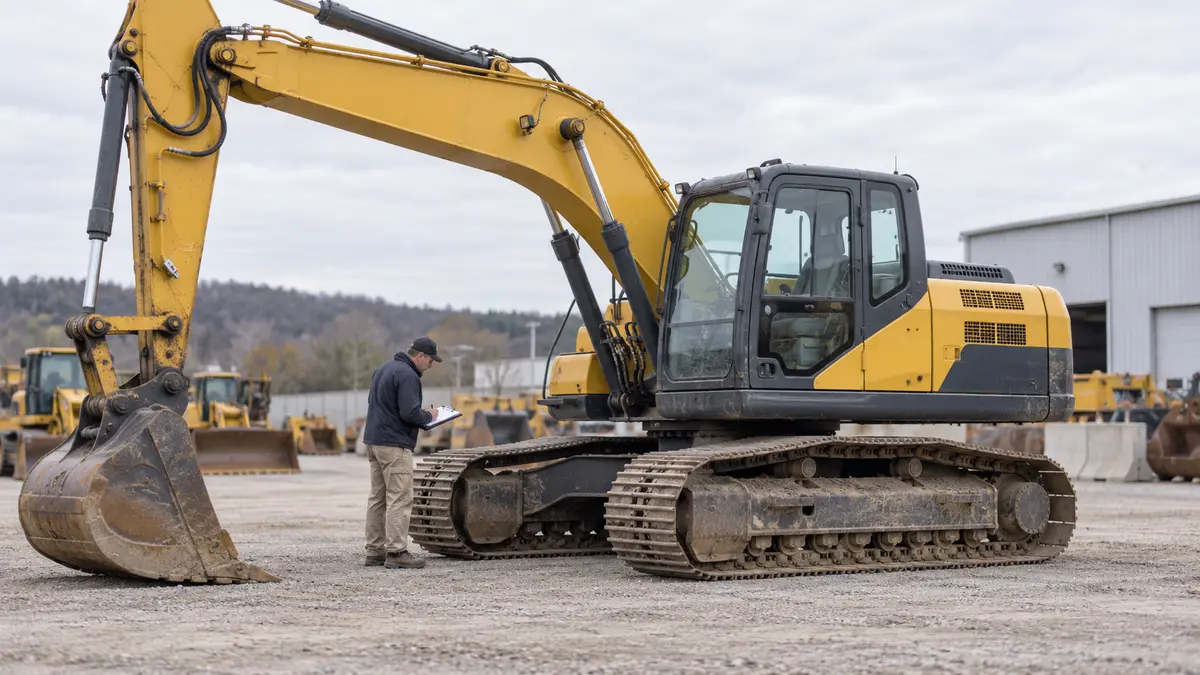
An inspection checklist is most useful when every finding leads to a record or a decision. A row of ticks without photographs, context or test limits can make an uncertain machine appear better understood than it is.
Use this worksheet to brief an independent inspector and organize a viewing of a tracked excavator. It is not a service procedure or a certification of safety. Model-specific measurements and operating tests belong with a qualified professional using the correct manufacturer information.
In This Guide
Before the Inspection Appointment
- Record the seller, location, machine model, serial number and asking price.
- Request service and repair invoices before the visit.
- Agree who will operate the excavator and what conditions the site permits.
- Ask the inspector to identify exclusions, access limits and any additional testing costs.
- Confirm that included attachments will be available for identification and assessment.
Ask for the machine’s condition at arrival to be recorded, including whether it was already running or recently cleaned. That context does not prove concealment; it tells you what the inspection could and could not observe.
Use Four Statuses for Every Item
Mark each line Observed, Concern, Not Tested or Not Applicable. “Observed” simply means the item was assessed and the finding is described. It should not be used as a blanket guarantee. Give concerns an evidence reference and a next action.
| Area | Record or Request | Follow-Up Question |
|---|---|---|
| Identity | Serial-plate photo and matching documents | Do all documents identify this machine? |
| Structure | Inspector’s assessment of boom, arm, body and repairs | Which repairs need further specialist assessment? |
| Running gear | Track and undercarriage condition report | What work is due, and what is included in the quote? |
| Workgroup | Findings at linkage, bucket and attachment connection | What requires measurement against manufacturer limits? |
| Engine and cooling | Observations, warnings and limitations | Was the cause diagnosed or only the symptom observed? |
| Hydraulics and travel | Results of agreed professional tests | What remained untested at this location? |
| Operator station | Controls, restraints, warnings and documentation | Are there defects requiring correction before use? |
| Attachments | Individual identification and included items | Is compatibility confirmed for the intended work? |
These are inspection topics, not universal pass/fail measurements. Bobcat’s manufacturer checklist includes visual, operational and safety checks across compact equipment. The inspection scope must be adapted to the actual excavator. Bobcat: Machine Inspection.
Separate Visible Findings From Diagnosis
A photograph can document wetness near a connection, damage to a track or a repaired area. It does not, by itself, establish the cause, remaining life or complete repair bill. Ask the inspector to label the difference between observation and diagnosis. “Leak observed; source needs confirmation” is more useful than an unsupported promise of a cheap fix.
For a running-gear concern, request an itemized estimate that explains whether the recommendation covers one part or a coordinated set of worn parts. Record labor, parts availability and any assumptions about additional damage discovered during work. Avoid turning a percentage quoted casually by a seller into a measured condition rating.
For looseness or unusual movement, ask which component was assessed and whether the conclusion came from a measurement or a visual judgment. Do not reproduce a test from a video if it requires positioning people near moving parts or using the attachment to lift the machine.
Observe the Demonstration From a Safe Position
Let the qualified operator and inspector establish the demonstration area and observer position. Stay clear of the movement envelope. Do not touch suspected pressurized leaks, open hot systems or enter beneath unsupported components. Stop the viewing if obtaining a result would require an improvised unsafe test.
Record the conditions of the demonstration: attachments fitted, tasks permitted, approximate duration, warnings observed and any reason it ended. Ask whether a brief yard demonstration was adequate for the question you were trying to answer. If not, the report should say what a further assessment would require.
Turn the Report Into a Cost and Decision Sheet
| Finding | Evidence | Decision Needed |
|---|---|---|
| Confirmed repair | Photo/report plus itemized quotation | Accept the cost, request completed work, or pass |
| Suspected problem | Observation without diagnosis | Authorize further assessment before committing |
| Untested system | Written access or demonstration limitation | Obtain a suitable test or account for unresolved risk |
| Document mismatch | Conflicting serial, date or repair entry | Resolve the discrepancy before payment |
Do not simply subtract an estimated repair bill from the asking price. Consider who will complete the work, how long it will take and whether your plan depends on the machine starting a job immediately. Put the findings into the ownership-cost worksheet.
Keep the Inspection Record With the Machine
Save the dated report, original photographs, quotations and seller responses together. If the seller completes work, request invoices and confirmation that the original concern has been addressed. A receipt for a replacement part is not always evidence of a complete repair.
Your final note should state one of three outcomes: continue, pause for named evidence, or pass. That short decision record prevents a later conversation about a discount from obscuring the unresolved issues that mattered at the inspection.
Sources and Scope · Research checked September 18, 2026. U.S.-first buyer education. This is an editorial research guide, not a report on a machine we inspected. Equipment-specific procedures and limits belong in the correct manufacturer manual.
See our Editorial Policy and send a correction.